
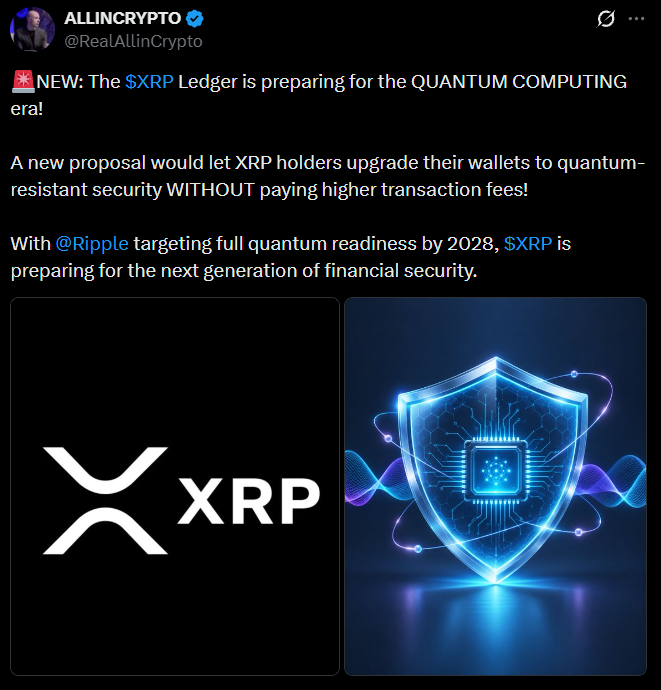
XRP Ledger Foundation designs quantum-resistant accounts using ML-DSA-44. Users add new keys and disable old ones at no extra cost, targeting full transition by 2028.
The XRP Ledger is preparing for a future in which quantum computers could break today’s elliptic-curve signatures. A design outlined in the XRP Ledger Foundation’s quantum study, part of its updated 2027 protocol roadmap, would let account owners add a quantum-resistant signing key and switch off the original one—without raising the base transaction fee for users.
The threat is already present on-chain. Every time an account signs a payment, its public key becomes visible. That includes exchange wallets and any active user account. A sufficiently powerful quantum computer running Shor’s algorithm could later recover the private key from that exposed data. The proposed upgrade closes that path by allowing owners to retire the vulnerable key once a stronger one is in place.
How the Quantum-Resistant Design Would WorkUnder the plan, accounts would support a new signing method based on ML-DSA-44, a lattice-based signature scheme approved by the U.S. National Institute of Standards and Technology (NIST) in 2024 specifically to resist quantum attacks. Owners would register the post-quantum key and then disable the classical one. The account address and balances would remain unchanged; funds would not need to be moved.
The new keys and signatures are substantially larger. Together they occupy 3,732 bytes, compared with 105 bytes for a standard payment today. Including history and database overhead, the Foundation estimates roughly 5,331 bytes of storage per protected transaction against a 1,704-byte baseline. Despite the increased data size, the proposal keeps the network’s base fee unchanged. Because XRP Ledger fees are destroyed rather than paid to validators, the extra storage cost falls on the operators who run the network.
Technical work is still incomplete. Developers are resolving inconsistencies in which the Python prototype and the server and JavaScript implementations can generate different keys from the same seed. Network testing and a formal migration study are planned for the first half of 2027, with further development and auditing expected later that year or in 2028. Ripple has separately targeted a full quantum transition by 2028.
Why Zero Extra Fees Matter for AdoptionMost blockchains that discuss post-quantum upgrades face a practical problem: larger signatures raise costs for users. By holding the base fee steady, the XRP Ledger design removes a direct financial barrier that could slow migration. That choice places the storage burden on infrastructure operators rather than everyday account holders—an approach that may encourage broader uptake once the feature is live.
The design also reflects a realistic view of the threat timeline. Quantum computers capable of breaking current cryptography are not expected in the immediate future, yet the exposure of public keys is permanent. Accounts that have already transacted remain vulnerable in principle until their classical keys are retired. Allowing owners to add protection voluntarily, without a forced migration or higher fees, gives the network a gradual path rather than a sudden switch.
Still, success depends on user action. The plan requires owners to actively disable the old key. Accounts that keep both methods enabled would remain partially exposed. Exchanges, custodians, and large holders will need clear tools and incentives to complete the switch. The scheduled 2027 migration study is expected to examine exactly how that process can work at scale.
Broader Implications for Blockchain SecurityThe XRP Ledger proposal is one of the more concrete post-quantum roadmaps currently public. It pairs a standardized NIST algorithm with a user-controlled migration and a commitment to keep fees stable. Other networks continue research or hybrid approaches, but few have published comparable detail on both the cryptographic choice and the economic design.
For the wider industry, the episode underscores that quantum readiness is no longer theoretical. Public keys already sit on ledgers. Networks that solve the storage and fee questions early may find themselves better positioned when regulators, custodians, or institutional users begin demanding post-quantum assurances. The XRP Ledger’s approach—protect the account, keep the fee the same, and give owners the switch—offers a pragmatic model others may study.
Work remains before any amendment reaches mainnet. Validators must still approve changes, auditors must review the code, and users must be educated. Yet the outline now exists: quantum-resistant accounts without an extra fee, built around a NIST standard, with a clear timeline toward 2028.
&

You can get bonuses upto $100 FREE BONUS when you:
💰 Install these recommended apps:
💲 SocialGood - 100% Crypto Back on Everyday Shopping
💲 xPortal - The DeFi For The Next Billion
💲 CryptoTab Browser - Lightweight, fast, and ready to mine!
💰 Register on these recommended exchanges:
🟡 Binance🟡 Bitfinex🟡 Bitmart🟡 Bittrex🟡 Bitget
🟡 CoinEx🟡 Crypto.com🟡 Gate.io🟡 Huobi🟡 Kucoin.











Comments